Desire, danger, and dissonant technologies
An interview with Tommye Blount <333 on long sentences, persona, his next book, and writing what we aren't smart enough to know.

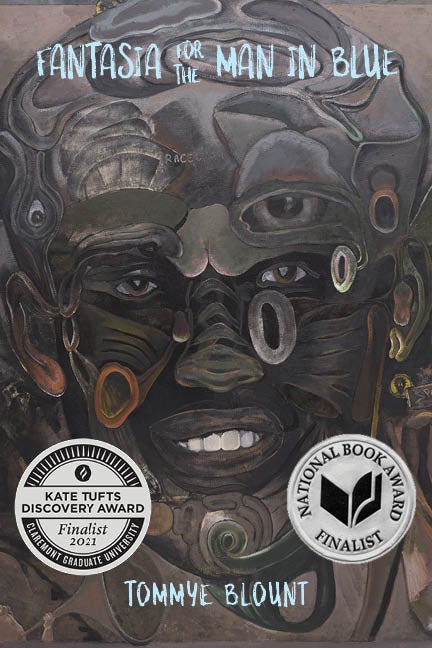
I read Tommye Blount’s Fantasia for the Man in Blue (Four Way Books, 2020) this year, and it immediately became one of my favourite books I read in 2025. What hooked me wasn’t just the voice, but the book’s movement—from word to line to poem to collection. It’s a beautiful example of a poetry book that teaches you how it’s built while you’re inside it, but also leaves you feeling like damn, I gotta figure out how to even begin to talk about this.
So that’s what this post is, plus a freaking lovely interview with the poet himself, which goes into his current practice, some craft stuff, and some beautiful films, artists, and musical influences. A book of poetry like this is such a gift, and I’m grateful to generous poets like Tommye who make this weird writing habit of ours feel more like a collective effort.
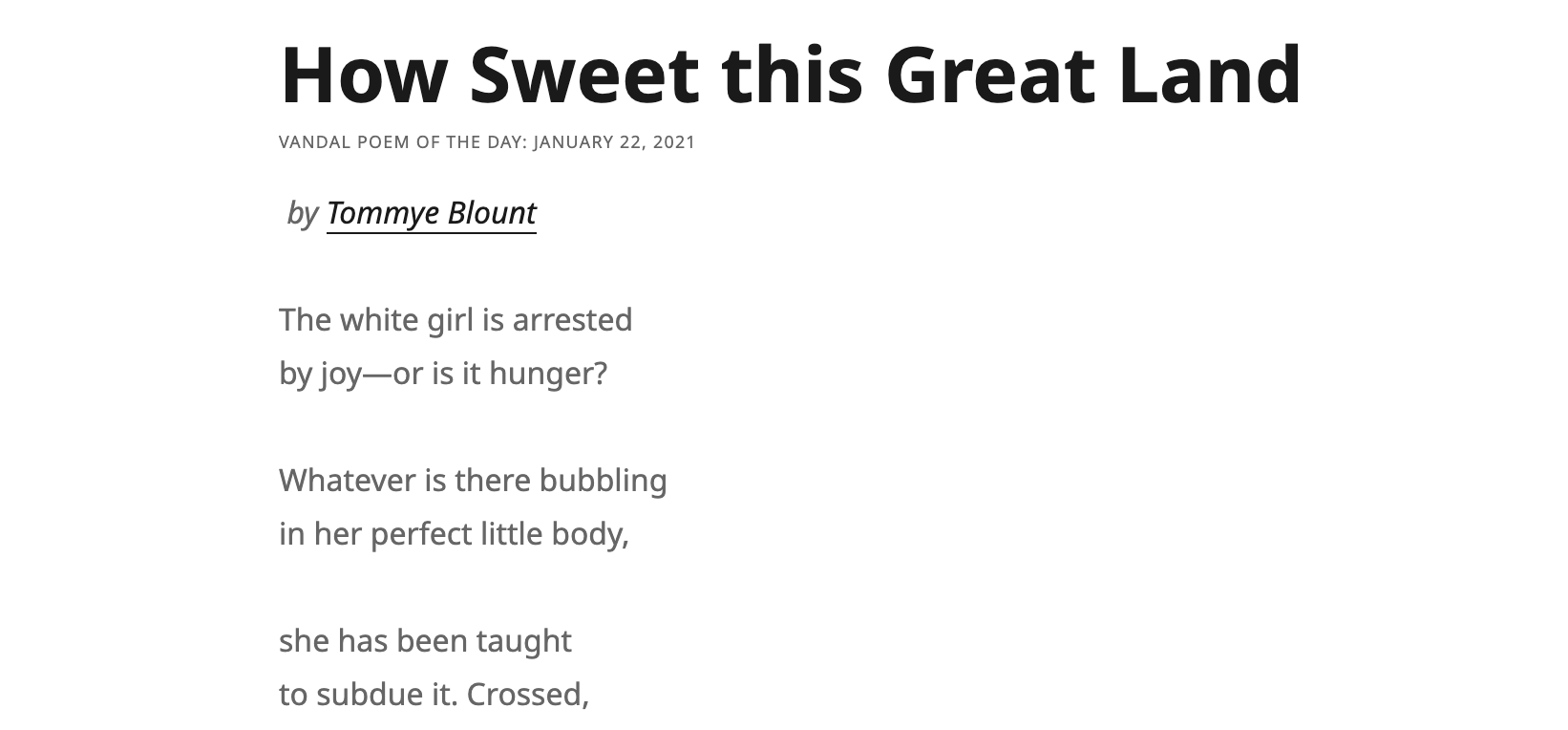
Brief notes on craft: The craft of Fantasia is driven by collision. Nouns and verbs shapeshift mid-line; metaphors contradict themselves across stanza breaks; syntax produces an “under-voice” that distracts from, doubles, or destabilizes the speaker’s claims (and where they collide with history). Meaning doesn’t arrive cleanly—it leaks out through pressure.
The result is a lyric “I” shaped by Black queer vulnerability and desire, a voice that emerges through slippage, substitution, and formal tension as a way of finding truth.
And now, an interview and fragments/prompts with Tommye. It’s long but I promise you it’s worth every letter, enjoy!
A Conversation with Tommye Blount: 🌹
DJP: In 2020 you said you loved long sentences; you likened your sentences to cinematic “long takes,” a way to manipulate time on the page (interview in The Adroit Journal), with many poems being composed of a single sentence. Has your sense of form changed? Are there new formal experiments you’ve been excited about since Fantasia, especially as you explore new work?
TB: I hate to say it, but not really. If anything, I have doubled down on how I view form, specifically sentence shapes and patterns. The pacing in my current work is more propulsive, has a more persistent throb to the way my sentences tumble forward. Semicolons, colons, and commas are doing everything they can to avoid terminal punctuation. I suppose there is a bit of desperation, not urgency, to why this is happening in the newer attempts.
The couplet, too, still haunts me. When people ask me why I write in them so much, I always joke that it is my tick. To be real, I love the way my syntax responds to couplets; the way couplets allow me to avoid closed stanzas as much as possible. A poem full of closed stanzas can be so claustrophobic and stiff. In novice poets, it has the feel of paragraphs. I go to prose for paragraphs, stanzas, like lines, can do so much more in a poem.
Of course, I write in other stanza lengths, but couplets always offer me surprising line breaks. They offer me an “under-voice” that creates double-talking in my work. While one speaker presents the poem’s argument, the under-voice distracts or meddles or contradicts that argument. I love a poem that struggles in this way.
DJP: Since Fantasia, has your sense of what vulnerability means in a poem changed? In 2020 you said vulnerability needed “some inherent sense of consequence” for it to be real. With the world shifting (socially, technologically, politically, culturally), has that threshold moved for you?
TB: Has the world shifted all that much? For me, it has always been a volatile place. The costumes and/or the actors change, but it is the same damn movie. When I was a child, my father used to say that I am not happy unless I am worried about something. (Amen, James Blount.) I am sure I am broken somehow, but the world is filled with nothing but the consequential.
Vulnerability is never something I am aiming to do. Did I say that in the interview? I was lying. Every day, I am questioning and re-questioning myself. (That might be a Gemini thing.) This sensibility just follows me into my poems. Whether in The Letters, in live theater, music, I love it when an artist shows their math. Seeing the mind think through something, then get it wrong and, thus, has to start over—that is exciting! Huh, that is another kind of vulnerability too, no?
DJP: When you talk about the performative/personal split—using personae, voices, shifting agency and the “you”/“I” membrane—has that approach deepened or transformed, now that the book has been out for over five years, and you’re working on a new collection?
TB: I will answer with a creative problem I face with my new attempts. While reading through some essays and articles about fashion history, just because I love that stuff, I learned that the Ku Klux Klan printed a mail-order catalog for its members in the early twentieth century. Of course, I had to find this catalog. I managed to download a pdf of one version, then freaked the fuck out. After two years on my laptop’s desktop, my brain started itching. I had to make sense of this somehow; had to contain it so that I could—I don’t know what.
There is this writing group called The Grind—started by poet and Bull City Press founder Ross White—that I sign up for every now and then. The Grind charges all writers who participate to write something each day, for that month, and email the writing to your group by midnight. Feedback is discouraged. It’s all about accountability. Because the Ku Klux Klan’s mail order catalog had been in my brain for so long, these cruel voices started coming out of me.
It terrified me, but I let the monologues ramble. At times, it still makes me uneasy to think that I am writing such work. I’m a Black gay man, why in the hell am I allowing these racist voices to share my body? Why let them live on in my own poems? It is when I read Robert Hayden’s “Night, Death, Mississippi” and go back to Cornelius Eady’s collection “Brutal Imagination,” I find my precedence, thus my permission. In both texts, that slippage between the “I” and the “You” is a signifier of rage, but not a naked rage. These are calculated poets. Both fully flesh out fiendish personae, in order to illustrate their absurdity.
DJP: How has your revision process changed or stayed the same since Fantasia, when you described writing as a seduction and revision as a way of getting so deeply inside the poem that “an alien version of myself” appears on the page?
TB: It takes me much longer to revise now. My mind doesn’t move as fast as it did when I was making the poems in Fantasia for the Man in Blue. It’s scary. We are always told to trust the process, but that is so hard to do. To answer your question more directly though, I am more cautious. There are things in my first book that I wish I’d done differently, so I bring that pressure to the new attempts. If I hear myself falling back into what I didn’t like about Fantasia, I shut down and put the draft away, and pout for a while. There is a distrust, I suppose, that I am battling against in revisions these days. Am I in the process or just failing? I sure can’t tell at this point.
DJP: Does the knowledge that Fantasia was received: read, praised, anthologized, awarded (e.g. Whiting Award in 2023)—change what you expect of yourself now, or what you allow yourself to attempt?
TB: I used to lie and say that I don’t feel pressure, but I do in terms of what is next. That capitalist emphasis on production gets to me at times. You know, before, I had no clue that people were paying attention to my writing. Not like that. My friends, of course, would encourage me about my work, but I had no idea the reach went beyond that. I still battle with that a bit. They say each time we, poets, write a poem, it’s as if we have never written one before. That’s how I feel. I have no clue what I am doing. That either does not bode well for me, or is it where I need to be for now? Hell if I know.
DJP: You’ve mentioned your next project engages technology, violence, and desire—threads that also pulse through Fantasia. Has anything felt particularly generative, new, or exciting in this new work that you’d like to share?
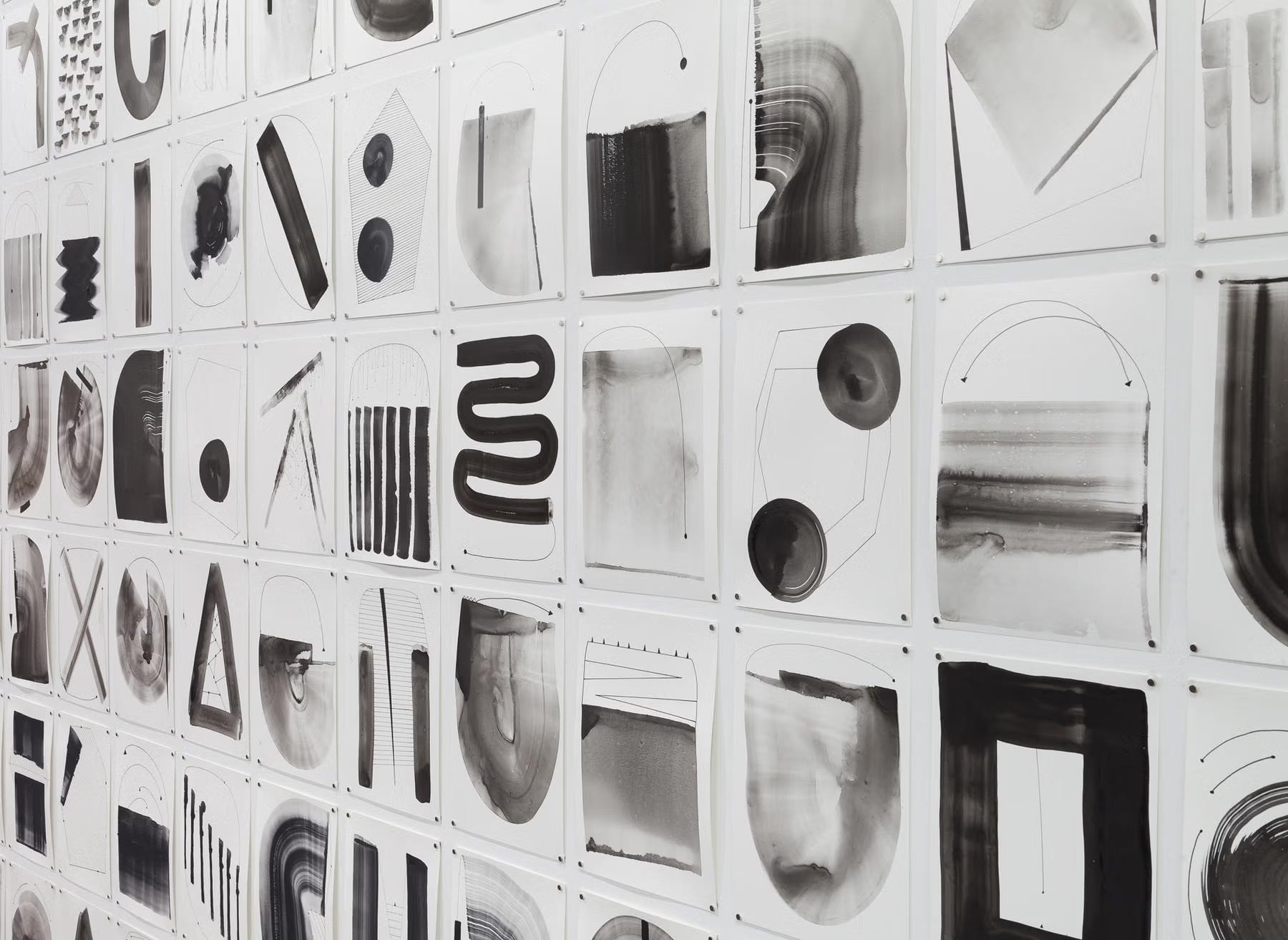
TB: I have been obsessed with the work of Torkwase Dyson over the past six years. An abstract artist, for lack of a better classification, she has developed a visual lexicon called “hyper shapes.” These are architectural shapes she has lifted from African American fugitivity accounts—narratives in which enslaved Black people ingeniously flee slavery by repurposing the containers, dwellings, holds meant to keep them imprisoned. Dyson uses these shapes, hyper shapes, as building blocks for her work, which presents a paradox that delights me. Historically, abstract art eschews narrative, but here is Dyson saying, “No, it can be both.” Details, ones I wouldn’t notice with my layman’s eye, are activated within new contexts.
This artist made me realize that I don’t know this world as well as I do. It’s a crisis of perspective—a good creative crisis. Taking my lead from her, I am thinking through a poetics I call “dissonant technologies.” As with Dyson’s shape activations, I am interested in the ways that seemingly mundane objects and architectures—intended for the greater good—are commandeered in pursuit of more sinister uses. The “handsome pistol” which ends “Fantasia for the Man in Blue,” all this time, has been leading me in this direction, but I am only recently realizing that fact. The work based on the Ku Klux Klan catalog is the first site of dissonant technology poetics that I have successfully managed, with any depths, so far.
DJP: Are there particular technologies—old, new, analog, glitchy—that you’re drawn to as poetic engines?
TB: It’s always the body. No matter what I am writing about, it’s through the fat-smudged lens of the corporeal.
Fragments / prompts:
I ended by asking Tommye to respond quickly to a series of prompts. So many good recommendations. 🍬
A film you return to when you need to remember what art can do.
When I am in a funk about how bad my writing life is, I watch the documentary Toni Morrison: The Pieces I Am. Her “late start” wasn’t late at all, which is comforting to a lowly writer like me. Look, everyone can’t be Toni Morrison. A lot of people want to believe they are, but that isn’t possible.
I was just talking to my friend, the brilliant writer, Perry Janes about how I use films to steal structural ideas. Jafar Panahi, Michael Haneke, Pedro Almódovar, Radu Jude, and Asghar Farhadi are just a handful of auteurs who get me thinking about structural possibilities. They make me ask myself, “How can I fuck with how and when information arrives in my own poems?” It’s always tricky for me knowing what to keep from an audience and what to trust they will figure out. The aforementioned have figured it out.
A song or album that shaped Fantasia or is shaping the new work.
Janet Jackson’s Rhythm Nation. The album’s first half covers heavy subject matter: bigotry, racism, famine, and more. Those who make it through the song “The Knowledge,” arrive at an interlude in which Jackson says, “Get the point? Good. Let’s dance.” From that point forward, the album—for the most part—slinks into a softer interior space in which love, longing, and joy pour out. Jackson’s whole self, her whole Black body, is allowed to meander, to dance, to take up so many spaces. The narrative is that “Control,” her second album, was when she stepped into her own. No, this third album is when Jackson let us know that she isn’t fucking around. Anyway, that largesse, that fullness, is what I wanted with Fantasia.
A visual artist you can’t stop thinking about.
Peter Williams, who I hope is resting ever so peacefully, gave permission for his “Portrait of Christopher D. Fisher, Fourth Reich Skinhead” to grace the cover of Fantasia. I remember sending him the poem I wrote in conversation with that painting. He loved the poem and was so encouraging to me. We never met in person, just over email. He passed away before I had a chance to meet him. His work and my work, I hope, reside in the same realm. Just as his work was at home in paradox, I too aim for that in my own work.
Also, Tylonn J. Sawyer, Sydney G. James, RaShaun Rucker, Sabrina Nelson, Bakpak Durden, and Mario Moore; visual artists with roots in my hometown of Detroit are always astounding me. I’m enamored with the way these artists complicate portraiture and self-portraiture, in the way I always wish to do with the lyric “I.”
Of course, again, Torkwase Dyson. Lastly, Philip Guston—whose work I love to argue with and for.
A scent you associate with writing.
Coffee! Different coffee scents are attached to different cafes in which I write. My apartment is terrible for writing, so I make a field trip out of it by getting into my car and working at different cafes twenty and thirty minutes away. Since I am jobless now, I get to do that more often.
A place—digital or physical—where you feel your imagination spark.
Imaginative sparks usually come from live performance spaces. I love live theater. When I had a job, and money, I would frequent theater in Chicago, New York, and Stratford, Ontario—the birthplace of Justin Bieber and Stratford Shakespearean Festival. Old movie theaters, complete with organist rising from underneath the stage, get me going too.
A recent obsession that snuck into a poem without you meaning it to.
The first and last time I went on Good Reads, someone commented that I write about blowjobs a lot in Fantasia. It’s true. I can’t help it. Maybe I should write a chapbook all about fellatio to get it out of my system.
A technology you distrust.
My body.
A technology you desire.
A healthy and living body.
A moment of beauty you witnessed this month.
It wasn’t this month, but a couple of months back. I was fortunate to be awarded a writing residency at Desert Rat Residency in Palm Desert, California. We don’t have freaking deserts in Detroit. I had never seen one in person. As my plane descended into Palm Springs Airport, in the shadow of the San Jacinto mountains, I started crying. I finally understood what the sublime meant. At that moment, I was both grateful and mournful. Grateful to be invited to the residency, yet mournful, because what took me so long?
A fear you’re writing toward.
In life and as a poet, I’m always afraid of being ill-equipped. I try to write and live the best way I can, but is that enough? Even when the first book was all set to go, I still felt like I had no business with a book? It always feels like the poets I admire have it all figured out. A Sisyphean task perhaps, but I write to know what I am not smart enough to know.
A pleasure you’re writing toward.
After a poem reveals to me the totality of what it wants to say, the form-making stage happens. This is the pleasurable part for me. I get to play and do whatever I want with the container. It’s like I have control in a way that I don’t in real life.